Showing posts with label thank you note. Show all posts

Thursday, August 6, 2015

You're Welcome


By Carly Smith, Assistant Director, Career Education

Take the next 30 seconds to think of a reason why sending a thank you note is a bad idea.

How many reasons have you come up with? Probably very few or none at all. So here’s a little tip for you as you enter the world of interviewing: always send a thank you note after an interview. 

You might be thinking right now, “Yea, a thank you note is cute and a nice gesture, but is it that important?” The answer is yes, it is very important, and here are a few statistics that will show you why you are missing out if you’re not on the thank you note train, or you’re ahead of the game if you’ve been writing them. A survey done by CareerBuilder of hiring manager found these following statistics:

22% of employers are less likely to hire a candidate if they don’t send a thank you note after an interview. That is reason enough to me to send a thank you note, especially when I just put in all the time to prepare for the interview.

86% said that not sending a thank you shows a lack of follow through. I want employers to find me dependable from day one. To be honest, I probably mark dependability as one of my major strengths when I am interviewing anyway so why would I tarnish that reputation before even getting the job?

56% said it indicates that the candidate isn’t really serious about the position. If you made the time to interview for this organization, you probably have at least some interest in the role. Employers want to hire individuals who are interested and enthusiastic about the work that the company does. Sending a thank you note can show that.

Finally, 89% said that is okay to send a thank you in the form of an email, which is an amount I feel will continue to grow as more tech savvy generations enter the workplace and are put in hiring positions. When it comes to email vs. hand written note, I am of the mindset that time is of the essence. Make sure your thank you is received in 48 hours, and if you can hand write a note and have it quickly shipped to your interviewers within that time frame, then go right ahead.

To sum it up, thank you notes convey your interest, show that you are gracious that the interviewers spent time getting to know you, and a great way to leave a positive impression before the employers make their decision.

Final tip: Each person you interview with should get their own thank you note. A big group thank you is easier, but an individualized note can be personalized and seem more genuine.


Now it’s time for you to actually write the cover letter, so check out our letter writing guide online to get started.
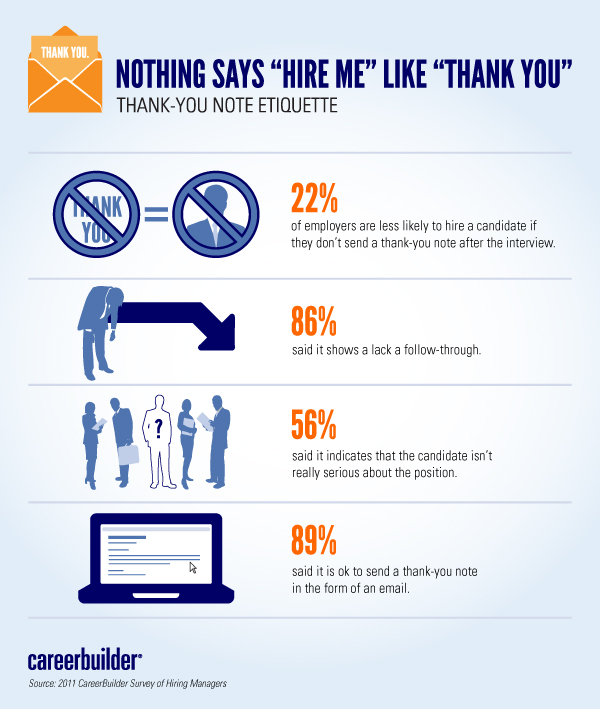

Thank You Note Etiquette.

Thursday, July 30, 2015

The Art of Interviewing, from a Career Advisor’s point of view…

By Ali Rodriguez, Director, Employer Relations

Over the years, I have interviewed many candidates for full time jobs, student internships, and professional positions. While working in higher education. I've learned a few things about what works, behaviors to avoid, and how to make a lasting positive impression.

Step 1: The initial contact
When the recruiter calls you to offer an interview, make sure you have your list of applications close-by. I’m always surprised when a candidate doesn’t remember applying to the job I am calling about. Also, demonstrate enthusiasm. I'm not implying you want to scream with joy over the phone, but be thankful and let that person know you are looking forward to the opportunity. If the organization reaches out by email, this can be more challenging, but it’s nice when a candidate is excited about an opportunity and shows it.

Step 2: The interview prep
If the interview is longer than an hour, ask for an itinerary. This will allow you to see who you'll meet with and plan accordingly. Research every person you will meet with, as you may discover helpful information. Prepare different questions for each person you meet with, and show specific interest in his/her job and background. I'm always impressed when a candidate knows where I went to college or specifics about my job. This shows that time and effort went into preparing for the big day.

Step 3: The interview is here
You've probably read about behavioral based interviewing, which interviewers use to determine how your past behaviors indicate future performance. What’s the best way to get a handle on these questions? Preparing examples in advance is important, and you should have many scenarios to discuss at the top of your head. Most importantly, you also want to research how recruiters in your field conduct interviews. Will there be a case study? What are some of those brain teasers? Should you bring a portfolio?

This goes without saying, but be professional. Dressing the part is easy, but how you interact with team members is critical to a successful interview. With that being said, don't get too comfortable during the interview. If you get a sense that the office culture is warm and welcoming, that’s wonderful; remember you are still auditioning for the part. Don’t act like you’re a part of the team just yet, but demonstrate that you are a good fit and would work well with others.

Step 4: The follow-up
Please, write a thank you note.  This seems so basic, yet so many candidates don't do it. Sending an email is fine, and it's important to demonstrate why you are the best fit for the job and reiterate what skills you bring to the table. I've had candidates interview with a group of 3-4 people, and then follow up with a group thank you email. This doesn't allow you to personalize the note in any way.  Take the time to connect with each person and that really will go a a long way.

Step 4: The offer

We all know that it’s a candidate’s market right now. Don’t take advantage of this. Be polite, follow up on all requests to interview, and evaluate all opportunities fairly. In an ideal world, you will have multiple offers (this is a whole different blog).  Negotiating the process can be tricky, and I highly recommend you talk to an advisor at the Toppel Career Center about the process. We are here to help as you secure that job or internship and have valuable resources as you work to achieve your career goals.

Monday, December 19, 2011

‘Tis the Season! Holiday Guide to Top Interview Tips


Written By Pallavi Pal

It is the season for enjoying the holidays, gifts galore, amazing home cooked meals, holiday parties, and all things merry! Everyone is usually excited about the holiday season for the festivities and fun but as a college student the holidays can be a time for interviews and applying for jobs or internships. But don’t let these interviews ruin your holiday cheer! Here are a few tips that most don’t know (or do) for an interview!

1. Do your research before going to the interview
Just as you prepare before a holiday party or celebration, you want to make sure you have prepared before the interview. Having done your research you appear a more knowledgeable and eager candidate. You can start off by doing informational interviews with current employees so you can get the inside scoop on the company, position and/or department for which you are interviewing.

2. Know how to sell yourself
When interviewers sit through 20-50 interviews for a particular position, the answers they get start to become generic. To set yourself apart from others strategize on how you want to market yourself. (Look for our blog entry on Jan. 12 about Personal Branding). There are many different sides to a person and if you are cognizant of the type of person you want to portray to the interviewer, you can tailor the experiences and skills that you highlight during the interview to reflect that specific persona.

3. Practice before the real deal
Just as the famous saying goes, “practice makes perfect,” rehearsing possible questions and answers can make you less nervous for the interview and can also be a great way to avoid those awful filler words such as “er” or “um.” Also, some difficult questions may require you to think carefully to answer the question. If you practice beforehand, the interview process becomes smoother and you won’t need to have awkward pauses anytime you are faced with a difficult question. If you want to get a list of general interview questions so you know what to prepare for, please check out Interview Preparation page on HireACane.com.

4. Chat up the Receptionist to get the inside scoop
So what can the receptionist really do for you? Well, the receptionist sits at the front desk everyday and they hear all the latest news and updates about what goes on in the office. Receptionists are a particularly good source of information mainly because they are willing and excited to talk to those who walk in to the office but also because they can be an untapped source of information. Moreover, the impression you leave on the receptionist can be passed along to the hiring managers through casual conversation. Some hiring managers would like to learn about how interviewees interact with others when they are not interviewing. Thus, hiring managers may ask receptionists about the behavior and attitude of the interviewees after the interview is over.

5. Have several questions prepared
Many disregard this piece of advice because they don’t think that their questions are being evaluated or have an impact. Questions should always be asked towards the end of the interview in order to not only show that you’re genuinely interested in the position but also to demonstrate the amount of research you’ve done. Stay away from questions that can be answered by simply looking at their website, questions regarding pay and compensation, and questions in which you ask them to tell you what type of candidate they are looking for. You want to ask them thought-provoking questions regarding recent trends in the industry, questions relating to strategy changes that the company is making or the department for which you are applying, and questions about the interviewer’s past experiences.

6. Bring several copies of your resume and thank the interviewer
This is a simple thing to do prior to the interview but it can leave a resounding impact on the interviewer(s). The reason we recommend to bring several copies is because sometimes interviews are held in a panel style or can be with more than one person. Bringing several copies of your resume can allow you to look prepared to handle anything. Moreover, you are supplying each of your interviewers with a copy of your resume without them having to share with another. Thanking them in person with a firm handshake towards the end of the interview can demonstrate your genuine appreciation for their time. These may seem like minute details, but these minute details can make you stand apart from your competition.

7. Send a thank you note
If you send your interviewer a thank you note, you may not automatically get the job offer but you will leave a lasting impression on the interviewer. It is a great gesture of appreciation for the time and energy they invested to interview you. Sometimes sending a handwritten note can mean a lot more to the interviewer than a typed, rather impersonal note.

To get more information on interviewing, please check on our Interviewing Skills Handbook and more blog entries on interviewing. Or you can stop in to Toppel for a Mini-Mock Interview that we offer to students on a walk-in basis!